
A Kauffman Museum traveling exhibit that debuted on the road in 2017 is back home at the museum on the Bethel campus through May 24.
“Voices of Conscience: Peace Witness in the Great War,” the current special exhibit, remembers the witness of peace-minded people against the First World War, 1914-18.
These included men and women, religious believers and secular humanitarians, political protesters and sectarian separatists, who resisted U.S. involvement in the war, the enactment of military conscription, the war bond drives, and the denial of freedom of speech under the Espionage and Sedition Acts.
As a result, many suffered community humiliation, federal imprisonment and mob violence at the hands of a war-crusading American public.
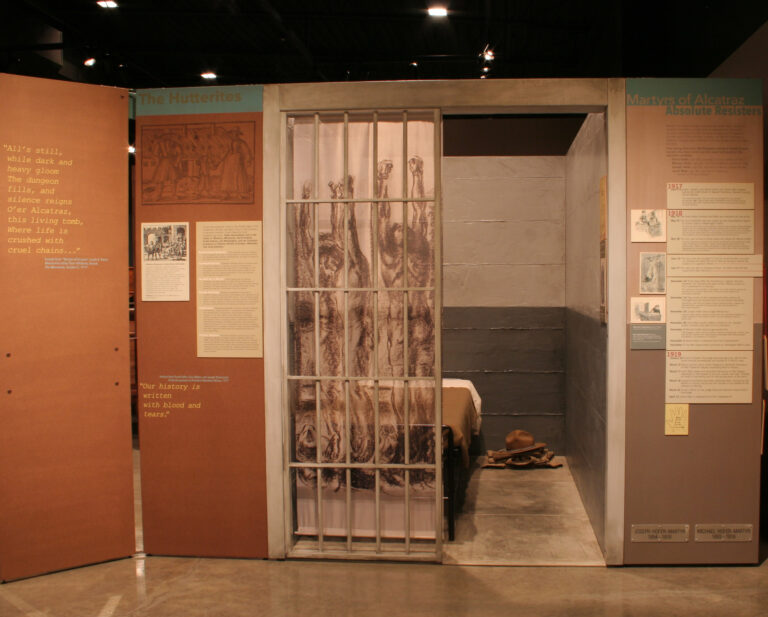
The exhibit is organized into theme modules that surround a re-creation of a cell at Alcatraz, a former maximum security federal prison off the coast of California, where Hutterite conscientious objectors were punished for refusing military participation during World War I.
In 1918, four young Hutterite men – brothers David, Joseph and Michael Hofer, and Joseph’s brother-in- law, Jacob Wipf – were absolutist objectors, meaning they would not accept even noncombatant roles. All were farmers in their 20s, married with children. They were court-martialed and sentenced to 20 years of hard labor.
While in Alcatraz, the four were tortured. In November 1918, they were transferred to Fort Leavenworth, Kansas, where Joseph and David died (the authorities claimed the cause was “Spanish flu”). Their families and fellow Hutterites considered them martyrs, killed by ill treatment.
“Voices of Conscience” premiered at the National World War I Museum and Memorial in Kansas City, Mo., during the symposium “Remembering Muted Voices: Conscience, Dissent, Resistance and Civil Liberties in World War I through Today,” Oct. 19-22, 2017.
The story of the Hofer brothers and Wipf was the catalyst that brought together a group of scholars from historic peace churches (Quakers, Mennonites, Church of the Brethren) and the Peace History Society in 2014 to begin planning a symposium.
After the symposium, “Voices of Conscience” had its first residency, at Rainbow Mennonite Church in Kansas City, Kan., before returning to Kauffman Museum for finishing work, and then beginning its life on the road.
The American Association for State and Local History gave “Voices of Conscience“ an Award of Excellence in 2020, making Kaufman Museum the only entity in Kansas to win a AASLH award that year.
The AASLH Leadership in History Awards is the most prestigious recognition for achievement in the preservation and interpretation of state and local history.
David Kreider, who retired as Kauffman Museum exhibit technician in late 2025, frequently traveled with “Voices of Conscience” over the years. “It has had a remarkable journey since its creation,” he says.
Since February 2018, “Voices of Conscience” has traveled to locations in 12 states and two Canadian provinces. Among the 24 host locations have been virtually all the Mennonite colleges as well as museums, heritage centers and churches.
Kreider recalled some of the more unusual host sites.
The Lancaster (Pa.) Mennonite Historical Society hosted the exhibit, but not in its own building – rather, in a local retirement community, Landis Homes, where the exhibit was available to view day and night.
In Aberdeen, S.D., the county museum hosted, but the nearby Hutterite colony underwrote half the exhibit expenses and provided all the installation help.
“It was a fun installation crew to work with,” Kreider said, “and we had the extra challenge of carrying all of the exhibit components up a flight of stairs to the second-floor exhibit area. On my return trip to take down the exhibit, I came a day early so I could stay overnight at the nearby colony.”
Host locations are encouraged to add a companion display that tells local stories of conscience.
Bluffton (Ohio) University developed an extensive interdisciplinary schedule of programming looking at their college’s engagement with the WWI period, using music, artwork, drama and historical archival materials to bring the community’s stories to life, Kreider said.
In Henderson, Neb., the Mennonite Heritage Park used “Voices of Conscience” as a catalyst to gather more than 300 local stories of people in their community who served their country in peaceful ways during times of war from the WWI era to the present. Those stories are now a permanent feature of the museum.
“It has been gratifying to see host sites add companion exhibits sharing the stories and artifacts from people in their own community who had a World War I peace witness,” Kreider said.
“The exhibit also helps people reflect on who are the voices of conscience in our communities today.”
Regular Kauffman Museum hours are Tues.-Fri. 9:30 a.m.-4:30 p.m., Sat.-Sun. 1:30-4:30 p.m., closed Mondays and major holidays. Admission to “Voices of Conscience” and the permanent exhibits – “Of Land and People,” “Mirror of the Martyrs” and “Mennonite Immigrant Furniture” – is $5 for adults, $3 for children ages 6-16, and free to Kauffman Museum members and children under 6. The museum store is open during regular museum hours. See kauffmanmuseum.org or the museum Facebook page for more information.