


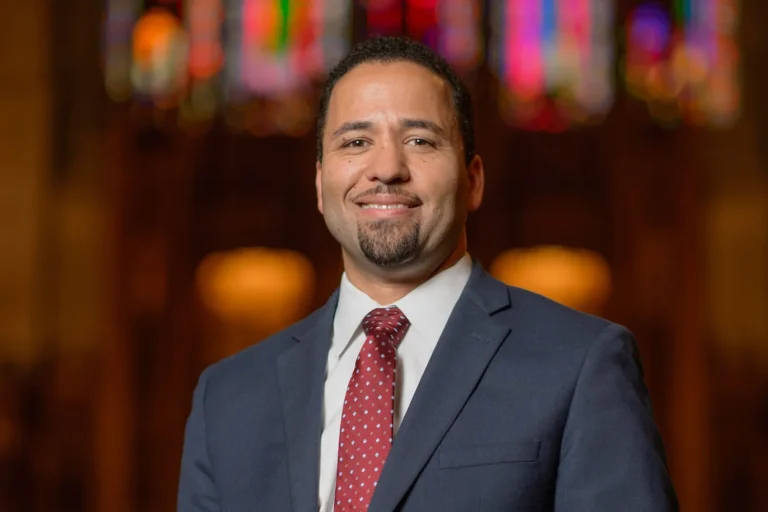
When Dr. Luke Powery takes the pulpit, expect singing as well as preaching. He would say the singing is (also) the preaching.
Powery was the featured speaker for Bethel’s biennial Worship and the Arts Symposium, held on campus Nov. 2-4. He preached the Sunday sermon at Bethel College Mennonite Church on Nov. 2, spoke in convocation on Nov. 3, and held a preaching masterclass with area pastors on Nov. 4.
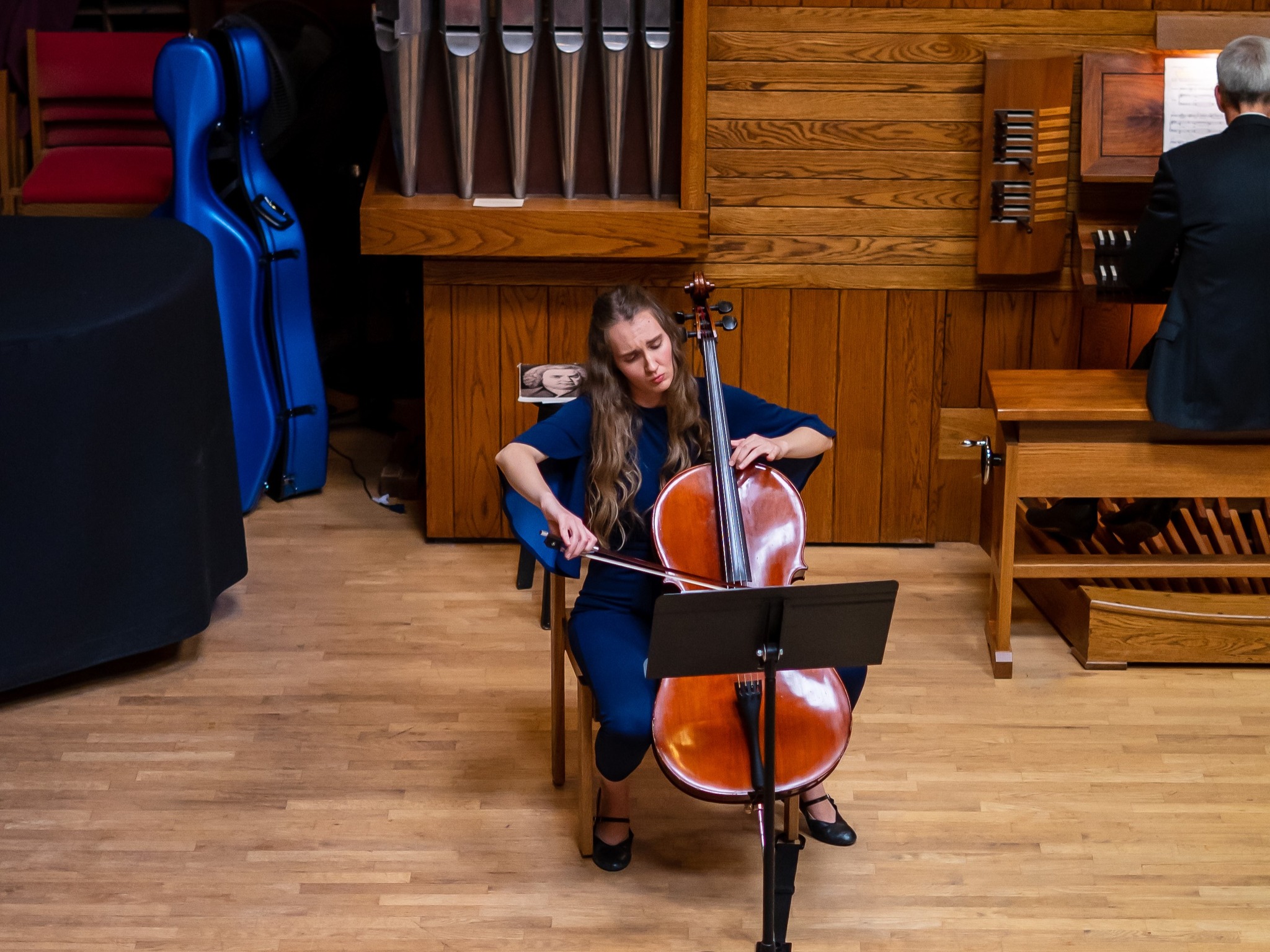
The symposium also included the annual choral showcase, Bethel Sings – the first as director of choral activities for Russell Adrian ’05 – and the opening of “Between Earth and Sky,” an exhibit of multi-media sculpture by former Bethel art professor Merrill Krabill, Goshen, Ind.
Powery is the dean of Duke Chapel (since 2012) at Duke University in Durham, N.C., professor of homiletics and African and African American studies at Duke Divinity School and the university, and an award-winning author or co-author of eight books. The title of the symposium, “Preaching Good News in a Troubled World,” is the subtitle of Powery’s 2023 book Getting to God (Cascade), with Jon Rottman and Joni Sancken.
Powery has graduate degrees from Princeton Theological Seminary (M.Div.) and the University of Toronto (Ph.D. in homiletics), and his undergraduate degree, from Stanford, is in music with an emphasis on vocal performance.
First-year student Mara Oswald heard Powery’s Sunday sermon and was drawn by that, and by “his powerful and captivating delivery,” to both his convo talk and the preaching masterclass.
His text for Sunday was from Matthew 4, Jesus’ 40 days in the wilderness and being tempted by Satan.
“I’ve heard this story many times, but there was one point he made that really captured my attention. He talked about how ‘even evil knows Scripture’ and that just stuck for me.
“In this current day and age, with the rise of Christian nationalism and the misuse of Scripture to fit harmful narratives, I feel that people often think their ability to quote more Scripture than someone else means they are ‘a better Christian.’ I do not this believe is the case because, as Dr. Powery pointed out, even the devil can quote Scripture.”
In his convocation “sermon,” Powery talked about “spirituals as preaching, teaching, telling the Good News.” He interspersed his points by singing lines from several spirituals, usually getting audience participation.
“Spirituals are theological or homiletical paintings of the human soul,” Powery said. “They show what it is to preach. Both spirituals and preaching are musical, textual, contextual, deeply communal in nature. Singing preaches and preaching sings.”
He said that “preaching good news should sound four notes”: the reality of human suffering; the reality of divine suffering (the cross of Christ); an ecology of community; and the viability of singing as a homiletical strategy.
Sophomore Abby Koontz was the Bible and religion department assistant last school year. “I had the privilege of helping set up Luke Powery’s visit and had been looking forward to hearing him in person since then,” she said.
“I’m happy to say that I was not disappointed at convocation on Monday morning. His overall message of preaching good news in a troubled world was something that resonated with me. What a relevant and powerful topic to address with everything that is going on in the world right now.
“Not only did his words connect with me, but his singing was what really stuck out to me. Music is a big part of my life and I feel the closest with God when worshipping through song. The spirituals he sang not only sounded good, but had beautiful messages within them. I enjoyed singing along.”
In all his talks, Powery emphasized the need to face into suffering as “being part of the gospel.” To deny that is to make preaching “a Sunday Chamber of Commerce exercise. It doesn’t take into consideration what life is all about, which includes death, heartache, pain and sorrow.
“[These things are] part of our theological memory, and the spirituals press us forward. Preaching is not spoiled by tears. Catastrophe and disaster are at the heart of the gospel – there are no resurrections without crucifixions.”
Powery reiterated his themes in the preaching masterclass, for which four local pastors – Shana Green from New Creation, Newton, Jerrell Williams ’15 from Shalom Mennonite Church, Newton, Joanna Harader from Bethel College Mennonite Church and Katherine Goerzen from Tabor Mennonite Church, rural Newton – offered sermons on “Preaching Good News in a Troubled World” and Powery commented.
First, however, he reflected on the question: What makes preaching “Christian”? How do we know it when we hear it?
True Christian preaching acknowledges human suffering, because “Jesus’ ministry was right at the heart of a broken society.”
It voices lament: “Avoiding pain and suffering in the pulpit doesn’t bring forth life,” Powery said.
And it voices hope amid suffering. “Hope is the spine of lament,” Powery said, “therefore it’s not cheap hope – it costs something. Hope is not the opposite of suffering – suffering is the necessary antecedent of hope.”
He continued, “Hope comes despite grief and suffering but not without it.”
He then related a story about “the best thing I’ve done at Duke in more than 13 years” – working with a group of men in prison, in 2023.
“The lesson I learned from one of those incarcerated students was ‘There’s no lament without “amen.”’ That sums up the whole gospel.”
Koontz and Oswald also attended the masterclass. “I went because I was interested in hearing him speak more,” Koontz said. “I knew the pastors he would be ‘teaching’ were local and I was interested in hearing their sermons as well.
“I’m very glad that I went! My Tuesday morning was overflown with beautiful messages helping me in my ongoing journey in faith.”
The Worship and the Arts Symposium, held at Bethel College every two years, is underwritten by the Reimer/Boese Worship and Arts Endowment, which celebrates the lives of Katharina Voth Reimer and Thomas U. Reimer, and Maria Schroeder Boese and Abraham L. Boese. The former are the parents, the latter the birth parents of the donor, the late Dr. Rosella Reimer Duerksen ’48.
Bethel is a four-year liberal arts college founded in 1887 and is the oldest Mennonite college in North America. Bethel is ranked #25 in U.S. News & World Report’s Best Regional College Midwest for 2026. Bethel was the only Kansas college or university to be named a Truth, Community Healing and Transformation (TCHT) Campus Center, in 2021. For more information, see www.bethelks.edu