




The first student show of Bethel College’s 2025-26 year reflects a number of the artist’s influences, including the natural world and some specific geographic locations.
“Forms of Nature,” Senior Exhibit I in the Regier Art Gallery, is Abby Chappell Deckert’s work in thrown pottery and ceramic sculpture.
The show opened Dec. 3 and runs through Dec. 12, with a reception Dec. 8 from 6-8 p.m. in the gallery in Luyken Fine Arts Center on campus.
Regular gallery hours are Monday-Friday, 9 a.m.-4 p.m., and Sunday, 2-4 p.m. There is no admission charge.
“‘Forms of Nature’ explores the beauty of plants, earth and the human figure,” Chappell Deckert said. “I chose to use clay in two different ways, through sculpture and through throwing.”
Having already finished a B.A. in Natural Sciences, Chappell Deckert had almost enough credits for a second major, in Art, and her show fulfills those requirements.
“When deciding what to do for my senior project, I primarily focused on throwing, … I chose to add sculpture because of how engaged I was with the process, and [because of] my desire to keep making figures,” she said.
Her human figures evoke Venus – “an embodiment of beauty, inspiration and love,” and an image found in many artistic movements, she said. “My goal was not to sculpt an idealized figure, but to look closely and be accurate.”
She stained the figures with red iron oxide and did residual salt firing, to produce multi-colored surfaces with minimal shine. This emphasis on organic material continues in the thrown work.
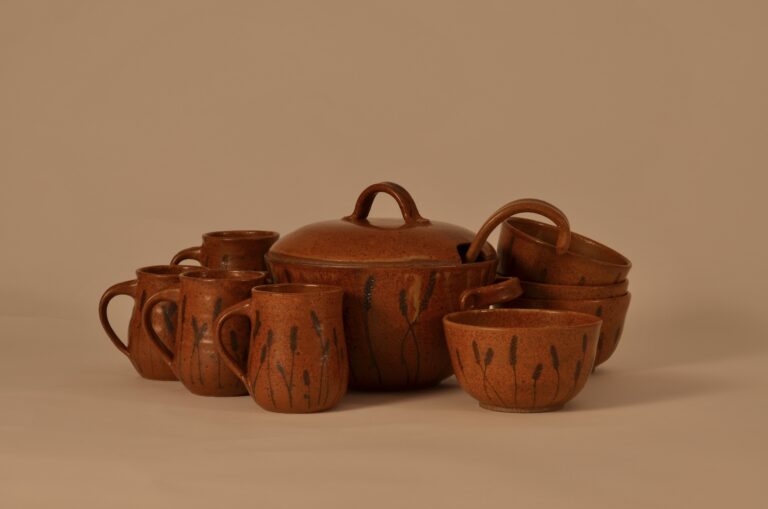
Chappell Deckert made her pottery sets with form and function in mind – for wine and cheese, for example, or for tea and cookies, or soup, or pasta.
“I’ve chosen to represent three geographic locations significant to my life,” she said, “‘Hibiscus’ for the tropics of Colombia, ‘Lupine’ and ‘Columbine’ for Michigan, and ‘Wheat’ for Kansas.”
She used a Japanese technique called mishima (which originated in Korea as sang’gam) – inlaying materials into carved lines.
“Mishima allows for a crisp yet organic image, preserving the integrity of the clay while showcasing detail,” she said. “Each glaze was carefully chosen to showcase the surface design. Variation in color is due to the unpredictable nature of reduction firing. Each firing process reinforces the show’s organic aesthetic.
“My hope is that you enjoy the beauty of nature throughout the forms represented in this show.”
Bethel is a four-year liberal arts college founded in 1887 and is the oldest Mennonite college in North America. Bethel is ranked #25 in U.S. News & World Report’s Best Regional College Midwest for 2026. Bethel was the only Kansas college or university to be named a Truth, Community Healing and Transformation (TCHT) Campus Center, in 2021. For more information, see www.bethelks.edu