







Bethel has an agrarian mascot – the Threshers – and agrarian history to go with it, one that Jason Schmidt dreams of restoring in the 21st century.
And if you’ve seen the flock of goats in the North Newton pasture just across K-15 from Thresher Stadium, they’re part of the plan, too.
At the beginning of the year, Schmidt began a new position at Bethel, grounds and land development manager.
For the past 15 years, Schmidt ran a small commercial dairy on the farm where he lives near Whitewater. He was the 5th generation of his family to do so on that property, but economic and personal realities forced him to significantly scale back his dairy operation late last year, pivoting to beef and row crops plus an off-farm job.
Schmidt grew up locally. He graduated from Hesston College, did a term of service in South Africa, where he got his first good look at sustainable agriculture practices, and then went on to Bethel.
There, he got a degree in global peace and justice, with a focus on international development, in 2004, followed by another term of service in Colorado’s San Luis Valley, and eventually a master’s degree in plant and environmental science at Clemson University.
Schmidt’s family has long ties to Bethel’s agricultural past. When Bethel was founded in 1887, it included a working farm, which remained part of the college until the late 1950s.
Schmidt’s maternal great-grandfather, Ernest Bachman, ran the farm until the ’40s. His maternal grandfather, Don Penner, worked for the college dairy in the ’50s – one result being that Schmidt’s mother, Jeanne Penner Schmidt, was born on campus.
Bethel sold the dairy operation in the late ’50s to Schmidt’s great-uncle, Allen Unruh, who ran it on-site until the college took the land to build Goering Hall and sports practice fields in the ’60s.
Bethel still owns agricultural land – such as the field where the goats now graze – on campus and off, but most is currently leased to others.
There’s also the part of Sand Creek Trail on campus property, the Kingsbury Prairie restoration in the southeast corner of campus, and Sand Prairie, a tract of virgin prairie in western Harvey County, among others.
And Schmidt has dreams that include all of it.
“I proposed this job, seeing that the land Bethel owns has all kinds of potential for conservation, student involvement and regenerative farming practices,” Schmidt says.
“On paper, at least, it looks like an obvious melding with our Employment Experiences program.”
He can envision student involvement – through both working on campus and developing skills that could lead to employment after college – in sustainable food enterprises, ecological land management, and marketing opportunities.
“Giving students the opportunity to learn to grow food and manage land in an environmentally sustainable way ties into the mission, core values and history of the college,” Schmidt wrote in his job proposal.
He imagines “exciting [opportunities] for students to learn how to develop business plans and sell the products and services from the sustainable food enterprises and ecological land management projects.”
He adds, “Bethel has a beautiful campus that I’m excited about developing a long-term vision for, creating greenspace capacity, and honoring our native prairies and native species.”
Most immediately, Schmidt has appointed himself “campus arborist, with a lot of help and input, to create a long-term plan for establishing trees that makes the campus look good and takes native species into account.”
Another project is working on the Kingsbury Prairie site, which Jon Piper, professor emeritus of biology, developed about a decade ago with grant funding and student help. Current biology professor Jean Woods has used the area in her classes as possible but has not had the time or help to maintain it.
Schmidt recently led the first prairie burn in several years on the prairie restoration and is hoping to work with the Sand Creek Trail Committee to eventually develop a southern “prairie spur” of the trail that will allow walkers to actually get into the prairie and look around.
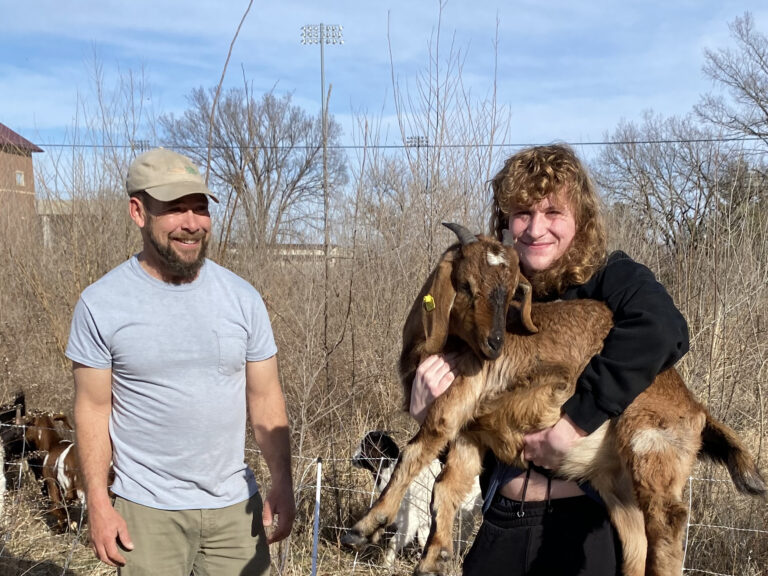
And yes, the goats. Goats are voracious consumers of young trees and shrubs, like invasive Siberian elms, Bradford pear and Tatarian honeysuckle, which is what they are munching on these days in the North Newton pasture that used to host Arabian horses.
“Part of the vision is to manage [invasive species] with goats,” Schmidt says. “I hope it’s a pilot project that can get students involved with managing them, moving them around campus.”
Longer term, he dreams of creating and using “regenerative farming/landscape management/small-scale farming models,” recruiting students interested in conservation, land management and sustainability, maybe even re-establishing an environmental science major.
“What is the best use [of all the land Bethel owns], that honors the land and makes sense for Bethel to own and manage?” Schmidt says. “What are enterprises on Kansas that can honor the whole history and mission of the college while pointing toward a sustainable future for the campus and the students who pass through here?”
Bethel is a four-year liberal arts college founded in 1887 and is the oldest Mennonite college in North America. Bethel is ranked #25 in U.S. News & World Report’s Best Regional College Midwest for 2026. Bethel was the only Kansas college or university to be named a Truth, Community Healing and Transformation (TCHT) Campus Center, in 2021. For more information, see www.bethelks.edu
Photo: Jason Schmidt, left, with first-year student Conner Harrison, returning a goat to the enclosure after it briefly escaped while the portable fence was being moved.