
Karen Reimer’s work, now on display in Bethel College’s Regier Art Gallery, is rooted equally in the traditions of domestic craft, and minimalism and conceptual art.
The resulting disjunctions, she says, allow viewers to consider the values and assumptions that underlie both those traditions.
“Made for you by a professional seamstress” is an exhibit of fiber art that Reimer has been creating since 1996. The exhibit’s opening reception is during Bethel’s 2025 Fall Festival, Oct. 3 from 6-8 p.m. in the gallery, located in Luyken Fine Arts Center.
Regular gallery hours are Monday-Friday, 9 a.m.-4 p.m., and Sundays, 2-4 p.m., with extra hours on Fall Fest Saturday, Oct. 4, 9 a.m.-4 p.m. There is no admission charge.
Reimer grew up in south-central Kansas, received a B.A. in art from Bethel College in 1982 and earned her MFA from the University of Chicago, in the city where she has lived most of her life since leaving Kansas. She is currently director of publications and registrar for The Renaissance Society at the University of Chicago.
“The particular work that gives its title to this show, and the others in the same body of work, are embroidered replicas of fragments and texts ranging from great books to fashion magazines,” Reimer says.
“Generally speaking, copies are of less value than originals. However, when I copy by embroidering, the value of the copy is increased because of the elements of handicraft and singularity – traditional criteria of artistic value. The copy is now also an ‘original.’”
The “fragment” that inspired the title embroidery is a copy of a page from a 1956 home economics textbook for high school girls “about how to dress, sew, look after their clothes and generally make themselves attractive,” Reimer says.
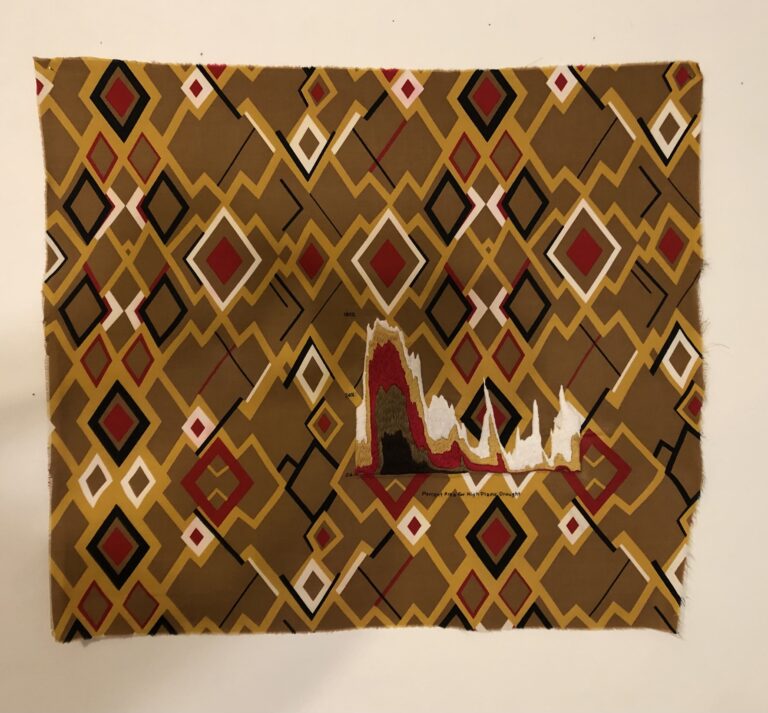
Her most recent work looks at patterns of data visualization – data about the changing climate and the results of that.
“Those data visualizations are embroidered onto fabrics printed with decorative patterns that have some kind of formal similarity to them – sharing shapes, colors, visual rhythms, etc.,” she says.
Many of her pieces are quilts made from old artwork.
“I think of the quilts as a way of kind of retiring material that has had a long life in my art – it’s been cut up, torn up, put back together, dyed different colors, etc., for use in several different installations.
“But it started in the world of usefulness – I got it from second-hand stores, out of my closets and as donations from friends and family – and it can now theoretically go back to a place of usefulness and interaction with bodies.
“Most of the dialogue around reuse in the art world refers to making art from formerly useful materials. I am reversing that, using old art to make useful objects.”
Reimer’s work has been exhibited at the Museum of Contemporary Art, Chicago; LAXART, Los Angeles; Salina (Kan.) Art Center; the Museum of Contemporary Craft, Portland, Ore.; the Beirut Art Center in Lebanon; Owens Art Gallery, Mount Allison University, Sackville, New Brunswick; Gallery 400, University of Illinois, Chicago; Maryland Institute of Art, Baltimore; and Monique Meloche Gallery, Chicago, which represents her work.
She is a recipient of the Artadia and Driehaus Foundation’s Individual Artist awards, and the Women’s Caucus for Art’s President’s Award. She has also received grants from the Graham Foundation for Advanced Studies in the Fine Arts and the Center for Craft, Creativity and Design.
Her 2015 monograph, Endless, was published by Whitewalls and Gallery 400 at the University of Illinois. Her work is also published in Reprint: Appropriation & Literature (Luxbooks Gmbh); The Object of Labor (MIT Press); By Hand (Princeton Architectural Press); Exchanging Clothes: Habits of Being II (University of Minnesota Press); and Art in Chicago: A History from the Fire to Now (University of Chicago Press).
Bethel is a four-year liberal arts college founded in 1887 and is the oldest Mennonite college in North America. Bethel was the first Kansas college or university to be named a Truth, Community Healing and Transformation (TCHT) Campus Center, in 2021. For more information, see www.bethelks.edu